
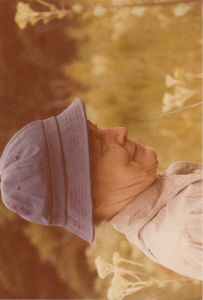
To celebrate Women's History Month, Archives and Special Collections highlights the Faith Rich Papers, a record of one of the lesser-known but very important women in Chicago history. Faith Rich was born Faith Baldwin in 1909 in Vermont. She lived a fairly sheltered life on her parents' dairy farm until she went to famed women's college Bryn Mawr. There, she met a French teacher who introduced her to socialism, of which Faith became an ardent advocate; so much so that she scandalized the leadership of Bryn Mawr, who initially refused to grant Faith her advanced degree. Faith would move to Chicago, and then her life got interesting.
While her husband, Ted, was serving in WWII, Rich worked as a labor organizer, most notably with the International Ladies Garment Workers Union, also helping workers learn to write in order to communicate with their relatives serving overseas. Rich's interest in education led to a job as a substitute teacher for Chicago Public Schools, where she was appalled by the unofficial but very real segregation.
In 1945, Rich, who was White, joined the NAACP, and would be an unpaid staff member for the rest of her life. She frequently chaired the Education Committee, including in 1956-1957, when she used her research skills to write her groundbreaking report: De Facto Segregation in Chicago Public Schools. She also testified in a hearing called by the state superintendent of public instruction on the matter not much later. Rich would also work on the NAACP's Textbook Committee, endeavoring to improve representation of underrepresented groups in American textbooks. Among other committee assignments were the Labor and Industry Committee, as well as being the contact person for the NAACP Bookmobile.
Around 1960, Rich quit her substitute-teaching job and joined the Congress of Racial Equality (CORE), and became Chair of the Schools Committee. This meant that amongst her other duties, she was the spoksperson for the committee to the Board of Education, including during the 1963 sit-in. As a general member of the Education Committee, Rich helped organize protests, edit testimony, and coordinate with other, like-minded organizations.
Faith Rich did not limit her concerns to civil rights. In addition to serving on the Collins High School Local School Council, she advocated for disability rights, the teaching of phonics for literacy, urban gardening, urban renewal (particularly in Lawndale, where she lived most of her life), keeping Harrison High School open, and many other progressive causes. Some of the other organizations that Rich held membership in were the Independent Voters of Illinois, the 15th Place Block Club, and Friends of the Douglas Park Branch Library. Rich also had an interest in Loglan, an invented language based on logic and simple grammatical rules.
Faith Rich never profited financially from her connections or her community work. She never owned a car. She never sought nor attained the leadership positions her experience and education could have afforded her. But if you needed something organized, someone to attend a protest or a rally, someone to answer a phone, Faith Rich was there. The eulogies at her memorial service in 1990 were full of specific instances of her commitment to community. If you want to learn more about about her extraordinary life and work, visit Special Collections at Harold Washington Libary Center to view her papers.

Add a comment to: Women In Chicago History: Faith Rich