
Play meets many vital humans needs, it helps us unwind, pushes our brains to think creatively and brings people together, strengthening connections. This has been true throughout history, as an archive can clearly show. For instance, one striking example is an 1860s folding pocket chess board from the Special Collections’ Civil War Collections that’s being preserved in the archives.
 World’s Columbian Exposition, dominos, 1893World’s Columbian Exposition, dominos, 1893, Chicago Public Library, Artifact 95.1.1

 World’s Columbian Exposition, dominos, 1893World’s Columbian Exposition, dominos, 1893, Chicago Public Library, Artifact 95.1.1

 A Century of Progress, Sky Ride playing cards with box, 1933A Century of Progress, Sky Ride playing cards with box, 1933, Chicago Public Library, Special Collections, Century of Progress, Box 17, Artifact 87.4.4a-c

 Century of Progress, Sky Ride playing cards with box, 1933Century of Progress, Sky Ride playing cards with box, 1933, Chicago Public Library, Special Collections, Century of Progress, Box 17, Artifact 87.4.4a-c

 Chess board, front, 1858Chess board, 1858, Chicago Public Library, Civil War Collection, SPE CW 91.4.41

 Chess board, 1858Chess board, 1858, Chicago Public Library, Civil War Collection, SPE CW 91.4.41

 Chess board, 1858Chess board, 1858, Chicago Public Library, Civil War Collection, SPE CW 91.4.41

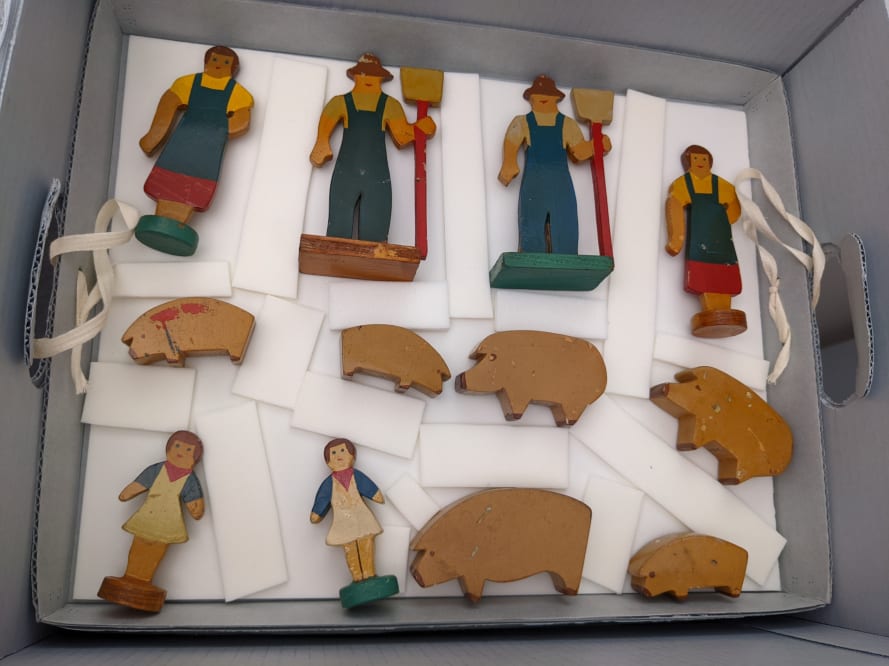
 Toy farm family and toy pigsSource: Chicago Park District Archives, Toys 2022.14, 2022.15
Handmade board games like these were common among soldiers, who passed long stretches of camp life playing checkers. These simple boards tell a deeper story about daily life during wartime, when soldiers looked for moments of distraction amid uncertainty. Games helped pass the long hours in camp and offered a small sense of normalcy. As noted by Robert I. Girardi in Campaigning with ‘Uncle Billy’: The Civil War Memoirs of Sgt. Lyman S. Widney, Illinois solider Lyman Widney recorded in his diary on January 15, 1862, “Rained incessantly all day, but we hugged the stove, argued politics and religion, laid out campaigns for our Generals, played cards, checkers and chess.”
Similarly, the Chicago Park District Records: Toy Collection includes early recreational toys used in Chicago parks, reflecting how public spaces evolved into hubs for organized play in the late 19th century. Over time, as playgrounds expanded, so did structured activities, laying the groundwork for today’s park programming.
From the grand spectacle of the 1893 World’s Columbian Exposition come dominoes produced as souvenirs that blended entertainment with commemoration. They’re small tangible reminders of the World’s Fair that helped bring art and culture to Chicago.
A few decades later, the 1933–34 Sky Ride playing cards from the Century of Progress Collection continued that tradition. With Art Deco flair and bold graphics, these decks captured the optimism and forward-looking spirit of the era.
If you’re fascinated by the evolution of play, don’t miss the LEGO exhibit, Stories that Click: Reimagining Chicago Brick-by-Brick, that opens April 3, 2026, in the Harold Washington Library Center’s ninth floor gallery. On display is a perfect bridge from 19th century parlor games to 21st century building bricks, showing how creativity, competition, and community have always been part of Chicago’s story.
Whether it’s a checkboard from a soldier’s knapsack or a fair-themed deck of cards, these playful artifacts remind us that history isn’t just preserved in documents, it’s in the games people played.
In the comments below, tell us what your favorite game is. How does it connect with your history?

Add a comment to: Toying Around with History